
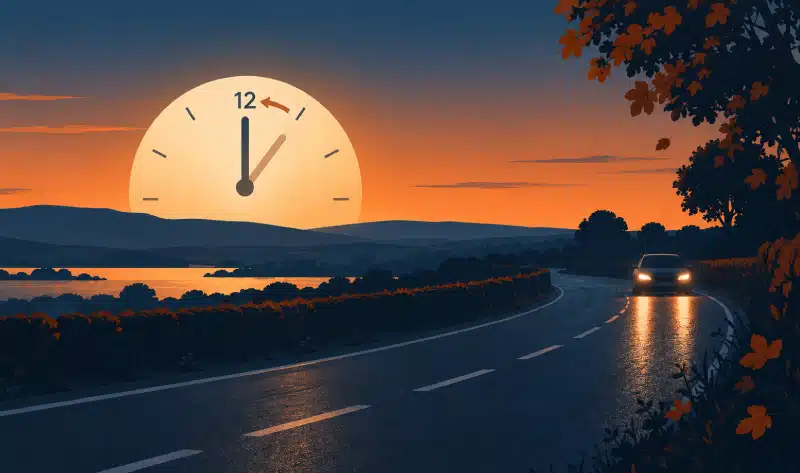
Every autumn, the clocks go back and the journey home feels different. A commute that happened in daylight only a few days earlier can now happen in darkness. Children may be walking home as visibility fades, and pedestrians and cyclists become harder to see.
So does the clock change itself cause more road accidents? UK evidence suggests collision numbers rise in the weeks that follow, but the explanation involves darker evening journeys, worsening autumn weather and other seasonal factors.
What the Numbers Actually Say
AA Accident Assist analysis looked at collisions before and after the autumn clock change in 2022, 2023 and 2024. It found that evening rush-hour collisions, between 4pm and 7pm, were 11 percent higher during the three weeks after the clocks changed than during the three weeks before.
Insurance data points the same way. AXA previously examined three years of motor claims and reported an average 7 percent increase in claims during the three days immediately after the clocks went back, particularly around the morning and evening rush hours.
But Is Darkness Really Responsible?
This is where the answer gets interesting. The RAC Foundation analysed six years of police collision data across Great Britain and found an average of 278 additional personal injury collisions during the two weeks after the autumn clock change, compared with the two weeks before. That is roughly 20 extra injury collisions per day.
Around three quarters of those additional collisions happened in the afternoon, which looks like strong evidence that darker evenings are responsible.
The weather matters too
The RAC Foundation itself urged caution. Its data also showed that collisions involving adverse weather rose at roughly the same time, because late October and early November bring more rain, fog, wind and wet roads. Its conclusion was that the increase probably reflects a combination of darker evenings and deteriorating autumn weather, rather than the clock change alone.
Turning the clocks back does not suddenly make roads dangerous. What it does is move darkness directly into one of the busiest periods of the day.
What's Actually Driving the Rise
Three different autumn hazards tend to arrive at the same time, which is why the weeks after the clock change are more collision-prone than any one factor would suggest on its own.
Darker evenings
Sunset moves directly into the evening rush hour. Pedestrians, cyclists and children become harder to see.
Autumn weather
Rain, fog, wind and wet leaves all arrive together, increasing stopping distances and reducing visibility.
Low sun dazzle
Sun angles drop sharply in October and November, with glare at its worst during morning and evening commutes.
Why the Evening Commute Changes
After the final Sunday in October, the available daylight does not disappear. It shifts. A driver who travelled home in reasonable daylight on Friday may find themselves making an almost identical journey in darkness the following week.
That change lands squarely on the evening rush hour, when roads are already busy with commuters, children returning from school and activities, pedestrians heading home and cyclists sharing the road. The AA's finding of a concentrated rise between 4pm and 7pm fits this pattern directly.
Pedestrians Are Particularly Vulnerable
Reduced visibility matters for everyone, but the consequences can be especially serious for people outside vehicles.
The Northern Ireland Highway Code advises pedestrians to use reflective materials in darkness, noting that reflective material can be seen by drivers using headlights from considerably further away than non-reflective material. Drivers also have their own responsibilities, with the Highway Code treating pedestrians, cyclists, motorcyclists and horse riders as particularly vulnerable road users. For more on how we handle serious pedestrian injury claims, see our serious injury claims page.
Children Walking Home in the Dark
Children are another group worth thinking about as the evenings become darker.
The clock change also falls immediately before Halloween, when more children may be outside during the early evening. That combination makes the final week of October a particularly sensible time for drivers to think about visibility around residential areas, schools, bus stops and parked vehicles. Where a child has been injured in a road accident, we handle these claims under our wider road traffic accident work.
Low Sun and Wet Roads
Darkness is only part of the autumn visibility problem. The weeks around the clock change also bring lower sun angles. In AA research published in 2024, 73 percent of drivers said being dazzled by low sun was the worst aspect of driving during autumn. Wet roads make the effect worse by reflecting sunlight directly at drivers.
Late October also brings wetter roads, which means visibility can drop at exactly the moment vehicles need more distance to stop.
Stopping distances double on wet roads
The Northern Ireland Highway Code states that stopping distances in wet weather will be at least double those required on dry roads, and that rain and spray can make it more difficult both to see and to be seen. Following the speed limit does not necessarily mean a speed is appropriate for every road and every condition.
Northern Ireland Has Seen This Pattern Before
Older figures from the Department for Infrastructure show how much road risk shifts into the hours of darkness during the winter months.
Proportion of NI road fatalities occurring in darkness
By time of year, five-year period reported in 2017
Those figures are historical and should be read as such. They do, however, illustrate why darker winter journeys have long been a road safety concern in Northern Ireland.
A Short Checklist for Drivers This Autumn
Simple adjustments that make a real difference
- Clean headlights, windscreen and wipers
- Carry sunglasses for low-sun glare
- Allow extra following distance in the wet
- Switch headlights on earlier than usual
- Watch for pedestrians near schools and bus stops
- Reduce speed when visibility is poor
- Check tyre tread and pressure before autumn
- Keep your mirrors and lights clean of leaves
If You Have Been Injured in a Collision After Dark
The fact that a collision happened in darkness does not determine who was responsible. The question is what actually happened and whether those involved took reasonable care in the circumstances. Poor weather or darkness does not automatically remove responsibility for a collision.
Evidence can be particularly important where visibility is disputed. Dashcam footage may show lighting and weather conditions, CCTV can help establish how vehicles or pedestrians were moving, and photographs taken shortly after a collision can record the road surface, street lighting and overall visibility. Witness evidence and police records may add further detail. If you have been injured in a collision and would like to discuss your options, you can learn more about our road traffic claims work or get in touch for a free consultation.
Do the clocks going back really cause more road accidents?
Not quite. But the weeks immediately afterwards do appear to be associated with more collisions, as darker evenings and worsening autumn weather land together on an already busy rush hour.
Injured in a road accident in Northern Ireland?
We can review the circumstances honestly in a free initial consultation and advise you on your options.