
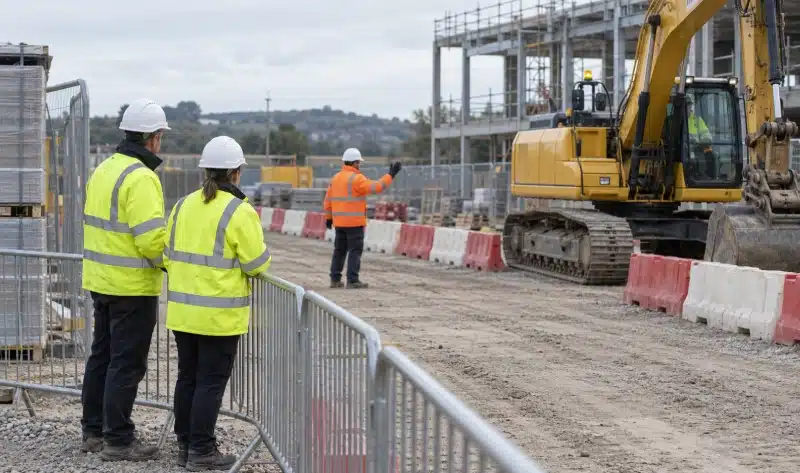
When a worker is struck by an excavator, dumper or forklift, attention naturally turns to the person operating the machine. However, legal responsibility does not automatically rest with the operator.
The workplace layout, visibility from the cab, condition of the machinery, supervision and coordination between different contractors may all be relevant. Establishing what went wrong requires an examination of how the work was planned and controlled, not only the final moments before the accident.
Different Machines, Similar Dangers
Excavators, dumpers and forklifts perform different jobs, but they create many of the same risks.
Excavators
May rotate or reverse into an area the operator cannot see.
Dumpers
May overturn on unsuitable ground or strike someone while travelling between work areas.
Forklifts
May collide with a pedestrian, lose an unstable load or trap someone against racking, machinery or another vehicle.
An injury can also occur without a direct collision. A worker might fall while attempting to avoid a vehicle, be struck by a falling load or become trapped between moving plant and a fixed structure.
Was the Operator Working Within an Unsafe System?
Operators have responsibilities for their own actions and for the safety of people who may be affected by them. However, even a trained operator can be placed in a badly designed or inadequately controlled working environment.
An investigation may consider
- Whether pedestrians and vehicles shared the same route.
- Whether blind spots had been properly assessed.
- Whether reversing could reasonably have been avoided.
- Whether assistance from a trained banksman was needed.
- Whether exclusion zones were established and enforced.
- Whether the operator received suitable training and site information.
- Whether cameras, alarms, mirrors, brakes and lights were working.
- Whether time or production pressures encouraged unsafe practices.
If the layout required machinery to operate close to pedestrians without adequate controls, focusing exclusively on the driver could overlook a wider safety failure.
Could More Than One Organisation Be Involved?
Construction sites and industrial workplaces frequently involve several businesses. There may be an employer, principal contractor, subcontractors, a plant-hire company and a separate maintenance provider.
Each organisation's potential responsibility will depend on its legal duties, the work it controlled and whether its acts or omissions contributed to the accident.
For example, an employer may have directed the injured person's work. A principal contractor may have been responsible for coordinating the construction phase. A subcontractor may have provided the operator, while another company may have supplied or maintained the machine.
How responsibility is assessed
The presence of several businesses does not mean that all of them are legally responsible. The contracts, working arrangements and evidence must be examined carefully.
What Evidence Could Explain What Happened?
Workplaces can change quickly after an accident. Machinery may be moved or repaired, barriers repositioned and CCTV footage overwritten.
Relevant evidence may include
- Photographs and CCTV footage.
- Witness accounts and the accident report.
- Risk assessments and method statements.
- Workplace traffic-management plans.
- Training and authorisation records.
- Daily checks, inspection reports and maintenance records.
- Available information from cameras, sensors or vehicle-tracking systems.
- Earlier reports of near misses or visibility concerns.
Previous warnings or near misses may help establish whether a particular risk was already known.
Injured in a Workplace Vehicle Accident?
Northern Ireland health and safety law places duties on employers and other workplace duty holders. Employees also have responsibilities to take reasonable care and cooperate with safety arrangements.
A health and safety failing will not, by itself, determine the outcome of a compensation claim. It remains necessary to examine negligence, causation, the parties involved and the injuries and financial losses suffered.
If you have been injured in an accident involving an excavator, dumper, forklift or other workplace vehicle in Northern Ireland, Paschal O'Hare Personal Injury Solicitors can investigate the circumstances and advise you on your options.
Injured in a workplace vehicle accident?
In a free initial consultation, we can discuss whether you may have a claim and who may be responsible.