
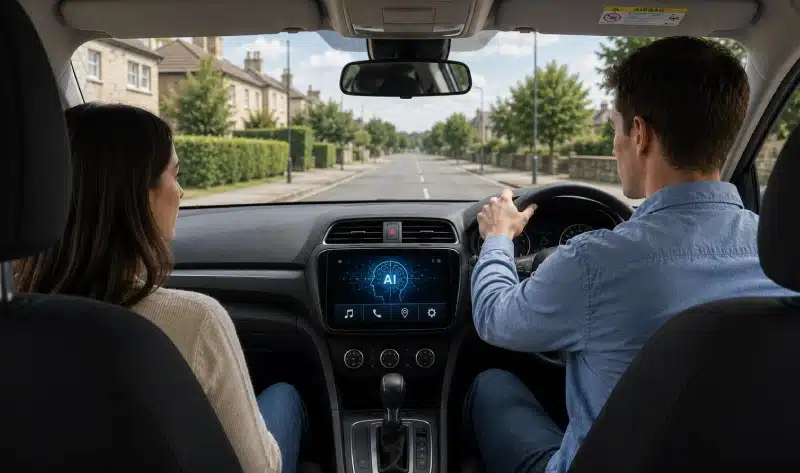
Artificial intelligence has moved quickly from novelty to background noise. It writes emails, recommends films, answers customer service questions, edits photographs and quietly shapes what we see online. Now it is finding a permanent seat in the car. Recent news shows how fast this is happening. Volvo is rolling out Google Gemini across many Android Automotive models built from 2020 onwards, giving drivers a more conversational voice assistant. Hyundai has unveiled its Pleos Connect infotainment system, with AI and an app ecosystem planned for Europe. Stellantis has announced a major Microsoft partnership involving more than 100 AI initiatives, including connected vehicles, predictive maintenance and digital cabin systems.
The Promise: Safer Roads Through Smarter Cars
The promise is attractive. A driver could ask the car to find a safer route, read a message aloud, explain a warning light, adjust the heating or suggest where to stop on a long journey. Used well, AI could reduce fiddling with screens and help drivers keep their eyes on the road. The UK Government is also looking at advanced vehicle safety systems, including intelligent speed assistance, emergency lane keeping, driver drowsiness monitoring and distraction detection, because human error, fatigue, speed and distraction remain central causes of collisions.
The Risk Hidden in Every Conversation
The risk lies in the word “conversation”. A car that understands natural speech may feel safer than a phone, but the driver’s attention still has to go somewhere. Asking a car to plan a journey, summarise a podcast or discuss possible stops may not require a hand on a screen, but it can still occupy the mind. On a quiet motorway that may feel harmless. On a wet Belfast morning, approaching a pedestrian crossing, a cyclist, a delivery van and an impatient traffic queue, that extra mental load can matter.
What Northern Ireland’s Roads Tell Us
Northern Ireland is a useful place to test the optimism. Our roads are not abstract proving grounds. They are narrow rural routes, school runs, city junctions, country bends, farm traffic, winter glare, sudden rain and pedestrians stepping out between parked cars. In 2025, 57 people died on Northern Ireland’s roads. Official figures also recorded 751 people seriously injured between January and September 2025, with “inattention or attention diverted” listed as the most common principal causation factor for KSI casualties during that period.
From Phone in Hand to Dashboard on Demand
That should make us cautious about any technology that turns the dashboard into another place to browse, chat, customise and consume. The old concern was a phone in the driver’s hand. The new concern may be a phone-like experience built into the vehicle itself. Hyundai’s new system has already been described as making the dashboard feel more like a phone, although with physical controls retained. Euro NCAP’s 2026 protocols point in the same direction, rewarding cars that keep physical controls for core functions such as indicators, hazard lights, wipers, horn and SOS functions.
That detail really matters. A button can be found by touch. A menu demands a glance. A voice assistant demands thought and, importantly, greater attention. None of these is inherently dangerous, but each can become dangerous if introduced at the wrong moment.
The AI We Actually Need in Our Cars
The better future is not a car that talks more. It‘s a car that interrupts less. AI should warn, simplify and quietly support the driver. It should not turn every journey into another connected experience. For Northern Ireland, where road safety campaigns continue to ask drivers to slow down, avoid carelessness and never use a mobile while driving, the question is practical rather than futuristic. Does the technology reduce the driver’s burden, or does it move distraction from the hand to the head?
That is where the real debate should begin. The safest AI in a car may be the one we barely notice.