
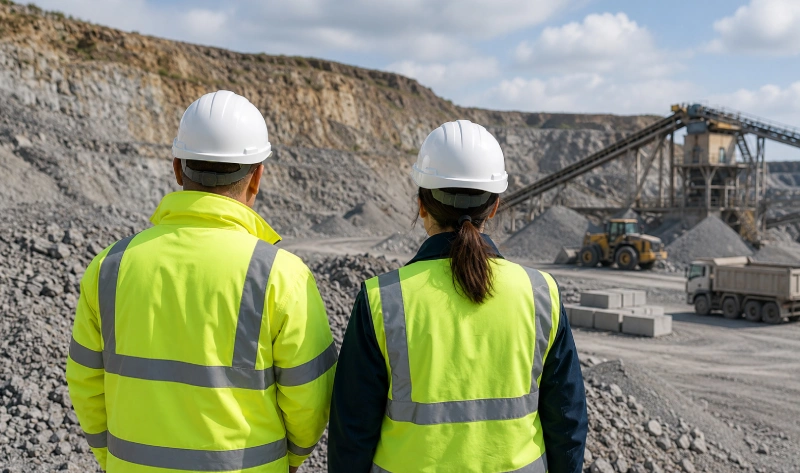
On 8 May 2026, the Health and Safety Executive for Northern Ireland (HSENI) and its counterpart in the Republic, the Health and Safety Authority (HSA), launched the first-ever joint all-island quarry safety inspection campaign. Inspectors from both jurisdictions will carry out two weeks of coordinated inspections at quarries and concrete block making operations across the island of Ireland.
The timing is not accidental. The statistics behind the campaign are stark.
Fatalities in Northern Ireland quarrying 2021 to 2025
Fatalities in the Republic of Ireland in the same period
Total lives lost on the island of Ireland in five years
What this campaign focuses on
HSENI inspectors will be assessing workplace transport and pedestrian vehicle segregation, training for forklift and loading shovel drivers, machinery guarding, conveyor safety, Lock Out Tag Out Try Out isolation procedures, and safe systems of work during cleaning and maintenance activities.
The Real Problem: Vehicles and People Sharing the Same Space
The campaign targets many hazards, but the one that kills most often is deceptively simple: vehicles and pedestrians operating in the same space with little separation.
In quarrying and block-making, the vehicles involved are not cars. A fully loaded loading shovel can weigh many tonnes. A forklift carrying blocks may have reduced forward visibility, particularly where the load is large or poorly positioned. An articulated dump truck reversing on a site has blind spots large enough to conceal a standing person entirely.
What makes this particularly troubling is that the solutions are well understood and not expensive. Clearly marked, physically separated pedestrian routes. One-way vehicle systems. Proximity sensors and cameras. These are not novel engineering challenges; they’re management decisions that either get made or don’t.
This Is Not Just a Quarry Problem
HSENI’s campaign is aimed at quarries. But the hazards it targets are present in almost every heavy industrial setting in Northern Ireland:
- Construction sites — shared access routes used by both HGVs and workers on foot
- Manufacturing and factory floors — forklifts operating in areas where pedestrian and vehicle routes are not properly separated
- Warehouses and distribution depots — high vehicle throughput in confined spaces
- Recycling and waste facilities — mobile plant working alongside manual operatives
- Ports and docks — heavy vehicle movements in environments where pedestrian access is rarely fully controlled
The legal duty on employers is identical across all of these settings. Under the Health and Safety at Work (Northern Ireland) Order 1978 and the Management of Health and Safety at Work Regulations (Northern Ireland) 2000, employers must assess foreseeable risks and put in place controls proportionate to those risks.
The Other Hidden Killer: Machinery and Maintenance Work
Workplace vehicle accidents draw the most attention, but unguarded machinery and conveyor systems cause injuries that are just as severe and just as preventable.
The HSENI campaign will specifically examine Lock Out, Tag Out, Try Out (LOTOTO) procedures, the formal isolation process that must be completed before any worker attempts to clean, maintain or unjam any piece of powered machinery.
LOTOTO failures follow a consistent pattern. A conveyor jams. Production stops. There is pressure to get the line moving again quickly. A worker is sent to clear the blockage without the machinery being properly isolated. The machine restarts. The consequences are catastrophic and irreversible.
What Injured Workers in Northern Ireland Need to Know
Injured at work? Three things that matter:
- Your claim does not depend on HSENI action — A personal injury claim and a regulatory investigation are entirely separate processes. You do not need to wait for HSENI to investigate, and a decision not to prosecute your employer does not prevent you from bringing a claim.
- The 3-year clock starts at the date of your accident — In Northern Ireland, you typically have 3 years to bring a personal injury claim. The sooner you take legal advice, the better your evidence position.
- Serious injuries require more nuance — Workplace vehicle accidents and machinery incidents frequently cause catastrophic injuries like amputations, spinal damage, and traumatic brain injury. Compensation in these cases is not just about the accident itself. It covers lost earnings, the full cost of future care, and the long-term impact on your life and the life of your family.
Speak to a Personal Injury Solicitor
Paschal O’Hare Solicitors advises people who have been seriously injured in workplace accidents across Northern Ireland, including vehicle accidents, mobile plant incidents, machinery injuries, and cases arising from failures in safe systems of work.
If you or someone you know has been injured at work, contact us for a free, no-obligation consultation.