
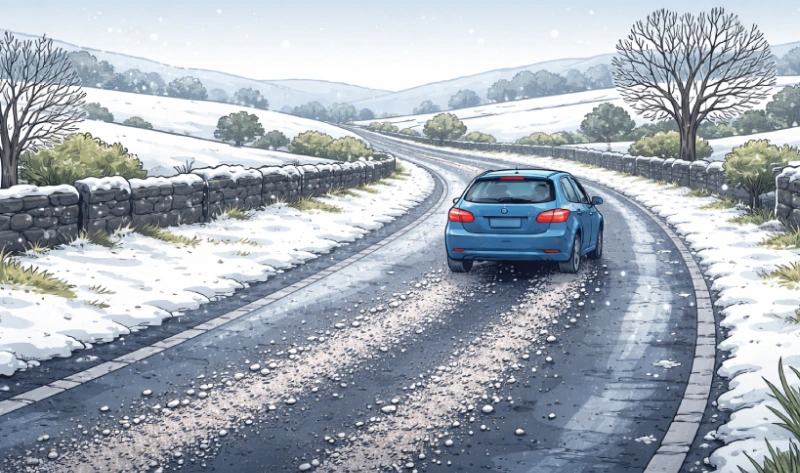
Winter driving in Northern Ireland follows a familiar pattern. Temperatures drop quickly after dark. Rain sits on cold surfaces. Frost forms in places drivers know well and places they do not expect. Road salt and gritting reduce risk, but they do not remove it entirely. Many winter accidents happen on roads that drivers assume are safe.
What gritting is meant to do
Salt lowers the freezing point of water on the surface. If it is down early enough, it reduces the chance of ice forming and sticking.
In Northern Ireland, the Department for Infrastructure salts a set network rather than every road. The Department has said this covers about 28% of the road network and benefits around 80% of road users.
That sounds reassuring. It also tells you something important, which is that a lot of roads are outside the routine plan.
Which roads get salted first
The winter service focuses on main through routes. The Department has described salting routes that carry more than 1,500 vehicles per day. Some roads with difficult conditions and traffic between 1,000 and 1,500 vehicles per day may also be included.
If you mainly drive on the big routes, you will see gritters more often. If you live off an estate road, a country lane, or a small town side street, you may not see them at all.
There is also a public map of the salted network. It can be useful when you are planning a journey in a cold spell.
Why road salt sometimes does not work
Salt has weak spots. Heavy rain can wash it off. The Department advises salt is not normally spread during heavy rain for that reason.
Quiet roads can stay slippery. DfI notes that traffic helps turn salt into a de-icing solution, so very low traffic roads are harder to treat effectively.
Timing matters too. If the temperature drops faster than forecast, ice can form in the gap between runs. Drivers notice this most at dawn, when the surface has cooled for hours, and the road still looks just damp.
The places that catch drivers out
Some spots are predictable.
Bridges and overpasses tend to cool fast. Shaded bends hold frost. Junction mouths get polished by braking. Roundabouts lose salt faster because of constant turning and stopping.
Then there are local hazards that salt does not touch.
Mud from farm entrances can freeze into a slick layer. Diesel spills stay slick in the cold. Standing water can hide ice underneath. A driver can do everything right and still slide.
Salt bins, grit piles, and what people can do
DfI Roads provides salt bins and grit piles for public self-help use in some locations, aimed at pavements and roads that are not normally treated.
They help with short stretches. They do not change the wider picture. A treated footpath does not make the road outside your estate safe. If you are driving in freezing weather, assume side roads are worse than main roads. Slow earlier than you think you need to. Brake gently. Leave space. Treat every dark patch as a risk.
When a winter crash turns into a claim
If you have been injured on the road during winter because of someone else’s negligence, you may be entitled to make a claim.
Paschal O’Hare Solicitors supports injured people across Northern Ireland with clear advice and steady guidance. If you would like to talk through what happened, we can explain your options and help you decide what to do next. Reach out today.