
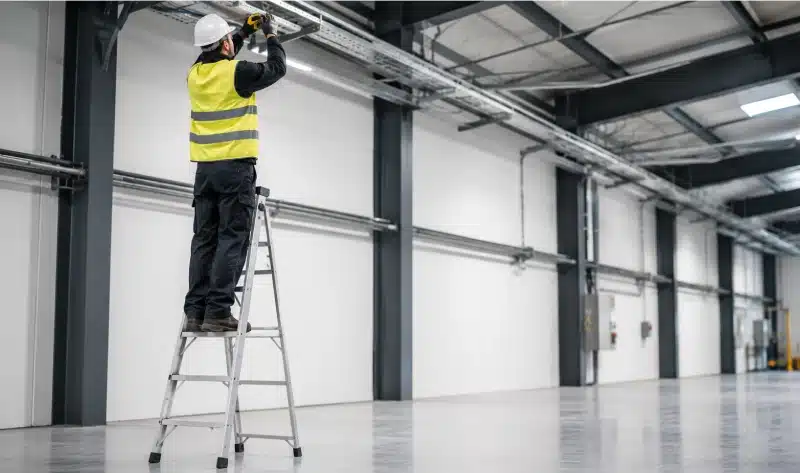
Many people associate working at height with scaffolding, roofs and tall ladders, which can create a dangerous assumption that safety obligations only kick in once someone is a certain distance above the ground.
In Northern Ireland, there is no minimum height at which the Work at Height Regulations (Northern Ireland) 2005 begin to apply. The question the law asks is whether a person could fall a distance liable to cause personal injury. The risk decides, not the ruler.
What Happened to the "Two Metre Rule"
The idea of a two-metre threshold has some historical basis. The previous Construction (Health, Safety and Welfare) Regulations (Northern Ireland) 1996 contained particular requirements where a worker was liable to fall two metres or more. Those regulations were revoked when the 2005 Regulations came into force.
The current framework focuses on the actual danger posed by a fall rather than the distance involved. A short fall onto concrete, machinery, exposed steelwork or another hard surface can still cause fractures, head injuries and other serious harm, and the Regulations reflect that reality.
Work at Height Can Begin at Ground Level
One of the less obvious aspects of the Regulations is that a worker doesn't have to be above the ground at all to be working at height. The legal definition explicitly covers work at or below ground level where a person could fall a distance capable of causing injury.
Situations the Regulations may apply to include:
- Working beside an open excavation, inspection pit or uncovered opening.
- Using a stepladder to access shelving, ceiling fixtures or storage.
- Standing on a raised platform, mezzanine or loading bay edge.
- Working on or beside the back of a lorry, trailer or vehicle load.
- Working close to an unprotected edge indoors or outdoors.
- Getting on to or off a place of work at height (access and egress are covered, not just the work itself).
According to HSENI, falls from leading edges, roofs, ladders and fragile surfaces remain among the most common causes of serious workplace injury in Northern Ireland. HSENI advises employers to consider not only the height of the task but the duration, frequency, and the condition of the surface a worker could fall onto.
Nine construction workers killed since 2020
HSENI reports that since 2020, falls have killed nine workers carrying out construction work at height in Northern Ireland. Its inspector Lee Dougan describes falls from height as "the single biggest cause of workplace fatalities and serious injuries in Northern Ireland." The figures reflect the sector where the risk is most concentrated, but the underlying legal duties apply across every industry.
What the Regulations Ask Employers to Do
Regulation 6 of the 2005 Regulations sets out a hierarchy that employers must follow in order, rather than jumping straight to protective equipment as a first resort:
Avoid
Consider whether the task can reasonably be carried out without working at height at all. If it can, the risk is removed at source.
Prevent
Where work at height cannot be avoided, take measures to prevent a fall happening. This typically means collective protection like guardrails, edge protection or properly erected scaffolding, rather than personal equipment used by one worker.
Mitigate
Where the risk of a fall cannot be prevented, suitable equipment should be used to minimise the distance and consequences. Personal fall protection like harnesses and lanyards sits at this level, not the first level.
Work must also be properly planned, appropriately supervised and carried out by workers with the necessary skills, knowledge and experience. Simple though it sounds, the hierarchy is a common area of enforcement: an employer who provides a harness without first asking whether the work at height was necessary at all has skipped the first two steps.
How Paschal O'Hare Can Help
Where a worker has been injured after a fall at work and an employer has fallen short of the hierarchy above, a claim for compensation may be appropriate. Our team handles claims across the range of workplace accidents in Northern Ireland.
Relevant service pages
You may find the following pages useful:
Injured after a fall at work?
The safety obligations don't start at two metres. If you've been injured after falling from a ladder, platform, vehicle, opening or another height at work, a free initial consultation will tell you honestly whether there's a claim worth pursuing.