
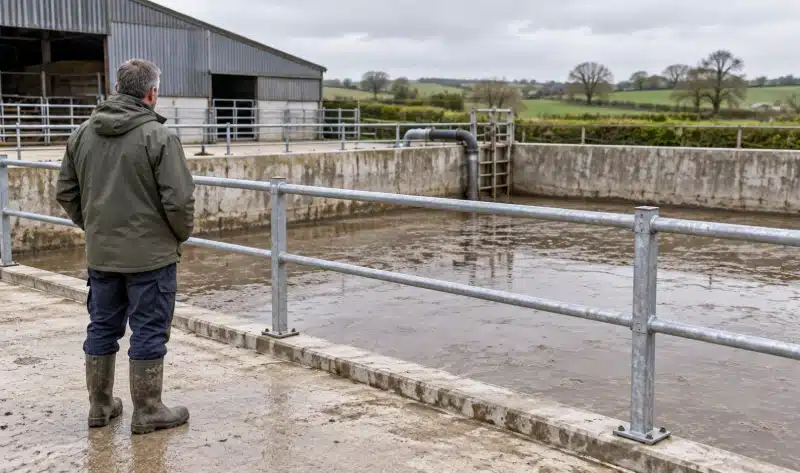
Slurry pits are a familiar feature on farms across Northern Ireland. They're also one of the most dangerous. Slurry-related accidents can happen in seconds, are often fatal, and the risks around a slurry tank are frequently underestimated by people who work near one every day.
What Is a Slurry Pit, and Why Is It Dangerous?
A slurry pit is a tank, usually below ground level or partially covered, used to store animal waste mixed with water. The mixture is valuable as fertiliser, but once decomposition begins it produces toxic gases that build up in the enclosed space above the liquid. Slurry is thick and viscous, which makes any fall into a pit almost impossible to escape from unaided.
The three main risks around a slurry pit are toxic gases, drowning, and slips and falls. Each can be fatal on its own, and they often combine to make rescue extremely difficult without specialist equipment.
The Three Main Risks
Toxic gases
Decomposing slurry produces methane, hydrogen sulphide, ammonia and carbon dioxide. These gases collect in the space above the slurry and can flood the surrounding area when the tank is opened or the slurry is agitated. Exposure at even short range can cause unconsciousness in seconds.
Drowning
A person who falls into a slurry pit cannot swim in slurry. The thick, heavy mixture pulls a person under and makes climbing out unaided almost impossible. Rescue attempts frequently result in multiple casualties when others try to help without proper equipment.
Slips and falls
The ground around a slurry pit is usually contaminated with a thin film of slurry, making it slippery in all weathers and dangerous in the wet. A fall near an unfenced pit can quickly become a fall into it, with the drowning and gas risks that follow.
Hydrogen Sulphide: The Silent Killer
Why hydrogen sulphide is the biggest danger
Hydrogen sulphide is released in dangerous concentrations when slurry is mixed or agitated. At high concentrations it can render a person unconscious within a single breath, with death following soon after. The "rotten eggs" smell most people associate with it disappears at concentrations that are already dangerous, so the sense of smell is not a reliable warning. Multiple farm deaths in Northern Ireland have involved hydrogen sulphide released during routine slurry mixing.
Legal Duties on Farms in Northern Ireland
Under the Health and Safety at Work (Northern Ireland) Order 1978, farmers who employ others have a legal duty to identify and control foreseeable risks. The Health and Safety Executive for Northern Ireland (HSENI) is the enforcing authority and publishes free guidance on farm and slurry safety.
Depending on the farm, that duty typically involves some or all of the following:
- Fencing, barriers and clear signage around slurry pits and tanks.
- Adequate ventilation before and during agitation.
- Keeping people, children and livestock away from the area during mixing.
- Training for anyone working near or on the tank.
- Providing appropriate personal protective equipment.
- Never entering a tank without proper breathing apparatus and a fully briefed rescue team on standby.
Where a farmer or employer has failed in these duties and someone has been injured, that failure may support a compensation claim.
What to Do If You've Been Injured
If you or a family member has been injured in a slurry-related accident on a farm in Northern Ireland, you may have grounds for a claim. This can apply whether you were an employee, a self-employed contractor working on the farm, a family member helping out, or a visitor. Claims involving fatal accidents can also be brought on behalf of the estate and dependants.
Time limits apply. In most personal injury cases in Northern Ireland, you have three years to bring a claim, running from the date of the accident or your date of knowledge. Different rules apply for children and for people unable to manage their own legal affairs.
For more information on farm-related accidents in general, see our farm accident claims page.
Injured in a slurry or farm-related accident?
We can talk you through your options in a free initial consultation. If we don't think you have a claim, we'll tell you plainly.