
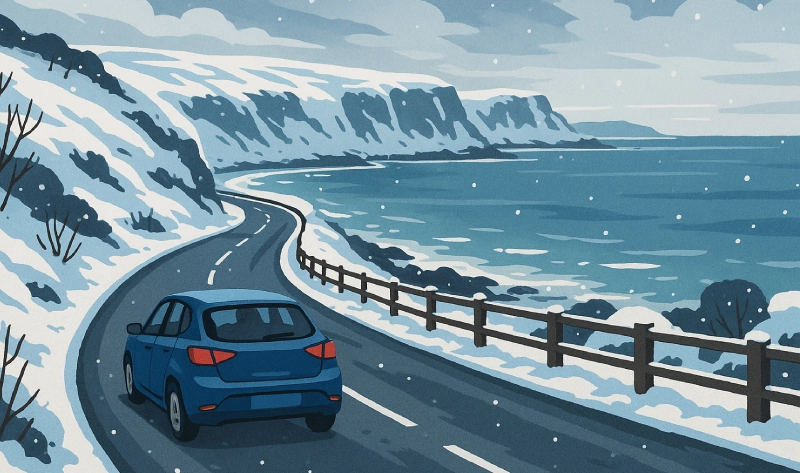
On a bright day with the tide out, there are few better drives than Northern Ireland's coast roads. In winter, the same routes can change in minutes. Weather comes in off the sea fast, the road surface can go from fine to treacherous within a mile, and a gentle bend on the Antrim Coast Road can feel very different with a gale behind it.
Anyone who drives the Causeway Coastal Route, the roads around Strangford Lough or the stretch towards the Foyle will know how quickly conditions turn. Here are the hazards that catch drivers out most often in winter, and what to do about them.
✓Reviewed by Patrick O'Hare, Managing Partner, Paschal O'Hare Solicitors
Why are coastal roads more dangerous in winter?
Coastal roads take the weather first. They're exposed to wind and spray from the sea, they often hug cliffs and headlands with tight bends, and storms can leave sand, stones and standing water on the road overnight. Add short days and low winter sun, and conditions can change faster than on almost any inland route.
Sea mist and spray
Sea mist doesn't behave like inland fog. It drifts in off the water in uneven patches, so one moment the road ahead is clear and the next you can barely see the car in front.
Spray from breaking waves adds to the problem. It leaves a salty film on your windscreen that wipers can smear rather than clear, especially when you're driving into low sun or oncoming headlights.
- Slow down as soon as visibility drops, not when you're already in it.
- Use dipped headlights in mist and spray. Full beam reflects back off the water droplets and makes it harder to see.
- Keep your screen wash topped up and your wipers in good condition.
- Leave a bigger gap so you have time to react if brake lights appear out of the haze.
Do coastal roads get gritted?
Some do, some don't. DfI Roads salts the main routes that carry more than 1,500 vehicles a day, which covers about 28% of Northern Ireland's roads. Busier coastal routes are often on that network, but many quieter shore roads and lanes are not.
Even on salted roads, ice can form on shaded bends and exposed headlands. Many drivers assume a dark patch is only wet, brake hard and lose control. On any coastal road on a cold morning, brake gently and early.
Sand, stones and flooding after a storm
Winter storms can throw sand, gravel and stones up onto the road and leave standing water where the drains have backed up. Sand on tarmac can be surprisingly slippery, and a stone under one wheel can pull the car sideways.
Take bends and headlands slowly after a storm, especially first thing in the morning before anyone has cleared the road.
Report it to DfI Roads
DfI Roads is responsible for public roads in Northern Ireland. You can report debris on the road online or call 0300 200 7899. For flooding, call the Flooding Incident Line on 0300 2000 100. Both lines are open 24 hours.
Strong winds on exposed stretches
Coastal winds hit open sections hard. You can feel steady one moment and feel the wheel tug sideways the next, especially as you come out from the shelter of a cliff or a row of houses. Vans and high-sided vehicles feel it most, but cars drift too.
- Slow down on exposed stretches and keep both hands on the wheel.
- Give cyclists, motorcyclists and high-sided vehicles extra room, as gusts can push them across the road.
- Watch for sand and light debris blown across the road in strong winds.
Busier roads over the holidays
Coastal routes can be busier in December and January than people expect, with family visits, winter walks and day trips to the seaside towns. On narrow stretches, a car pulling in for a photo or stopping at a viewpoint can bring traffic to a halt. When visibility is poor and the surface is slippery, those sudden stops are when rear-end collisions happen.
Your questions about coastal road accidents
Can I claim if another driver caused my accident on a coastal road?
Possibly. Bad weather doesn't take away a driver's responsibility to drive to the conditions. If another driver was going too fast for the road or didn't leave enough space and you were injured, you may be able to claim against them and their insurer.
What if debris or a defect in the road caused the accident?
It depends. DfI Roads has a duty to maintain public roads, so a claim may be possible if a defect, missing sign or hazard they knew about, or should have known about, contributed to your accident. Claims based only on weather, like storm debris that arrived overnight, are usually much harder.
How long do I have to make a claim?
You generally have three years to issue court proceedings for a personal injury claim in Northern Ireland. The three years usually run from the date of the accident, or from when you first knew about your injury and its cause, if that's later.
How we can help
Paschal O'Hare Solicitors has helped people injured in road accidents across Northern Ireland since 1969. If you were hurt on a coastal road this winter, we'll talk you through what happened and explain your options clearly.
Injured on a coastal road this winter?
Talk to our team about what happened and whether you may have a claim.