
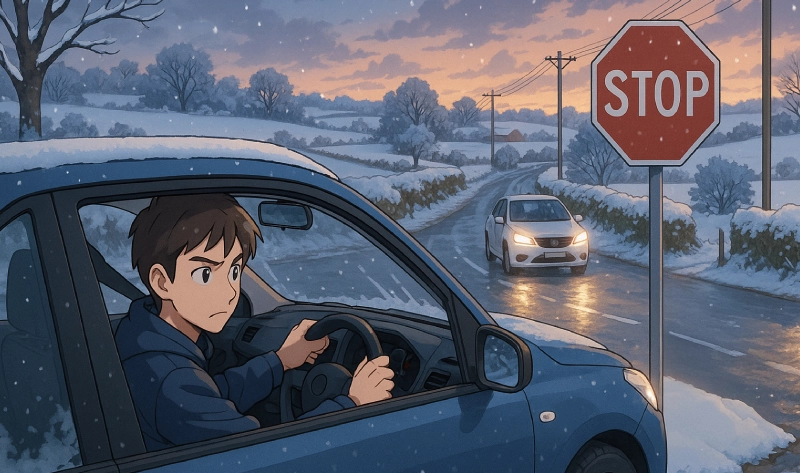
Rural roads link farms, villages and small towns right across Northern Ireland. Sharp bends, blind crests and tight junctions already need careful driving. In winter, those same junctions get much harder to judge.
Daylight goes earlier, road surfaces cool quickly and traffic changes. An ordinary turn can quickly become dangerous. These are the problems we see most often, and the ones worth keeping in mind this winter.
Fog, rain and early darkness
Winter light doesn't last long here. Plenty of rural junctions are hard enough to read on a bright summer morning. Add fog rolling across a field or a heavy shower and you might only see a few metres ahead.
Headlights coming through mist can play tricks on your eyes. Glare from an oncoming car can hide a tractor pulling out or a car slowing to turn. Slowing down and using dipped headlights helps, but you still rely on verges being cut back, signs being visible and sight lines being clear. When hedges are overgrown or signs have faded, there's very little room for error.
Ice on untreated roads
Main roads are usually gritted, but many rural roads are not. Frost lingers in shaded spots the sun never reaches, and ice forms at junctions where water collects. One sharp press of the brake can send a car sliding out into the main road.
Farm traffic adds to the problem. Mud carried out of fields can sit on the road all day, and when the temperature drops it becomes slick and unpredictable. Even experienced drivers get caught out.
Farm machinery appearing without warning
Farm work doesn't stop for winter, and some farms are busier than ever. Large machinery moves between yards and fields, often around dusk. High hedges and narrow lanes can hide farm entrances until the last second.
A driver who has used the same road for years might not expect a slow-moving tractor around the next bend. Someone pulling out of a side road might assume the way is clear and move across the path of a vehicle they never saw. Side impact collisions like these can cause serious injuries.
Poor lighting and old layouts
Many rural junctions follow old layouts that were never designed for today's traffic. Some have no lighting at all. Others have worn markings that are hard to read in the wet.
Locals may know these junctions well, but visitors and delivery drivers following a sat nav often arrive too fast for the conditions. If you were injured at a junction where the signs, markings or road surface had been poorly maintained, this may be relevant to a claim.
Busier roads over the holidays
December and January bring more travel across Northern Ireland. Families visit relatives and students come home. Rural junctions that are quiet in summer carry more traffic just when conditions are at their worst.
More traffic means more chances for a misjudgement. A brief lapse in concentration on a dark, wet evening can lead to a collision involving several vehicles.
Your rights after a rural junction accident
If you were injured at a rural junction because of someone else's mistake or neglect, you may be able to claim. Whether you can depends on what happened and who was responsible.
Who might be responsible
Most claims are against another driver and their insurer. In some cases, the person who left mud or debris on the road may be responsible. DfI Roads has a duty to maintain public roads, so a claim may be possible where a defect, missing sign or worn marking contributed to an accident. Claims based only on ice on an unsalted road are usually much harder.
Compensation may cover your pain and suffering, medical treatment, lost income and the longer-term effects of your injuries. Paschal O'Hare Solicitors gives clear, practical advice to people injured in road accidents across Northern Ireland.
Hurt in an accident on a rural road?
Talk to our team about what happened and whether you may have a claim.