
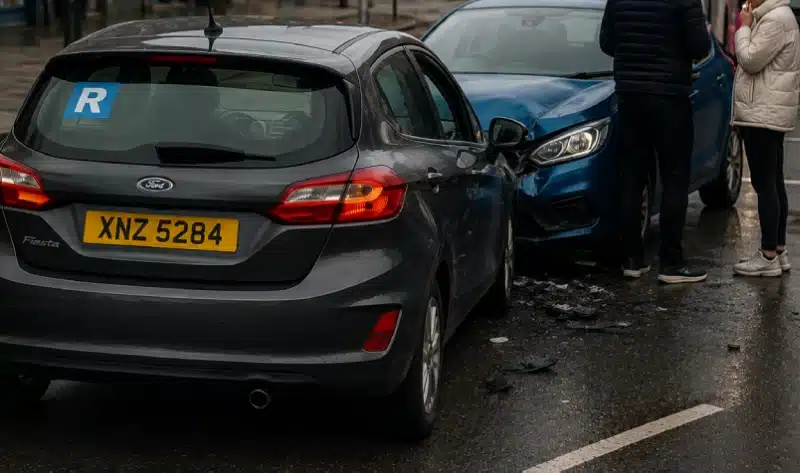
If you have been injured in an accident involving a newly qualified driver in Northern Ireland, your solicitor should check which driving restrictions applied and whether any breach is relevant to your claim.
Northern Ireland introduced Graduated Driver Licensing on 1 October 2026. Transitional arrangements mean that drivers qualifying under the existing system will continue to share the roads with drivers covered by the new scheme. Your right to compensation will depend on the evidence about how the accident happened and what caused your injuries.
Which rules apply to the driver?
Passing a driving test after 1 October 2026 does not automatically place someone under the new Graduated Driver Licensing rules.
The transition matters for accidents before April 2027
Car learners whose first provisional entitlement begins on or after 1 October 2026 normally have to complete a six month learning period before taking their practical test. Their earliest test dates will therefore generally fall in April 2027 or later.
An exemption from that waiting period applies to learners who can prove entitlement to Carer's Allowance. Those learners must still complete the required training and logbook.
Drivers whose car provisional entitlement began before 1 October 2026 and who pass before 1 April 2027 generally remain under the existing system. They must display amber R plates and observe the 45 mph restriction for one year. The new GDL passenger restriction does not apply to those drivers.
This means amber R plate drivers will continue to be on the roads into 2028 as their individual restricted periods come to an end.
Drivers covered by GDL must display a blue R on a white background for six months, then a white R on a blue background for another 18 months. GDL imposes no additional speed restriction on newly qualified drivers. They must obey the ordinary speed limits applicable to their vehicle and the road.
The driver's licence history and test date therefore need checking before identifying a breach. The nidirect guidance for newly qualified drivers explains the rules and transitional arrangements.
What restrictions could be relevant to your accident?
For a car driver still under the existing amber R plate system, the 45 mph limit applies throughout their one year restricted period, including on roads where the posted limit is higher. Any lower applicable speed limit must also be observed.
Evidence that a driver exceeded an applicable speed limit may help establish how a collision happened. The court will still consider whether the driving caused or contributed to the accident and injuries.
When does the GDL passenger restriction apply?
For GDL drivers under 24, the first six months include a passenger restriction between 11 pm and 6 am. They may carry no more than one passenger aged 14 to 20 during those hours.
Exemptions apply to immediate family members and where someone aged at least 21, who has held a full driving licence for three years, occupies the front passenger seat. This restriction applies to car drivers covered by GDL, rather than drivers remaining under the existing amber R plate system.
What counts as a breach under GDL?
The Department for Infrastructure identifies the following offences and potential penalties under the new scheme:
GDL breaches and their penalties
The fine shown is a maximum, rather than an automatic amount. The information offence can concern the driver, the vehicle owner or another person required to provide the information.
The Road Traffic (New Drivers) (Northern Ireland) Order 1998 provides for licence revocation when a new driver reaches six or more qualifying penalty points during the probationary period.
Two separate three point endorsements could therefore reach that threshold. However, offences committed on the same occasion do not automatically produce six points. Under Article 30 of the Road Traffic Offenders (Northern Ireland) Order 1996, the general rule attributes the highest applicable points figure, although the court can depart from that rule.
Does a breach affect civil liability?
The connection to the accident matters
A personal injury claim usually requires evidence that the driver failed to take reasonable care and that this caused or contributed to your injuries. A licensing breach alone does not establish those elements.
The Highway Code can be used as evidence when deciding liability. A breach of a driving restriction may also be relevant, depending on the circumstances and its connection to the collision or injuries.
For example, evidence that a driver was speeding or being distracted by passengers could help explain how a collision happened. The absence of an R plate, by itself, may say little about who caused the accident.
If you suspect a breach, tell your solicitor and preserve any relevant evidence. They can assess its significance alongside the driver's actions and the other circumstances of the accident.
What if the driver has been convicted?
A relevant criminal conviction can be admitted as evidence in civil proceedings. Under section 7 of the Civil Evidence Act (Northern Ireland) 1971, the convicted person is presumed to have committed the offence unless the contrary is proved.
That presumption concerns the offence. A conviction for carrying an unauthorised passenger does not automatically prove that the driver caused the collision or your injuries.
Your solicitor should consider what the conviction establishes alongside witness accounts, footage, medical evidence and the other circumstances of the accident.
What if you were a passenger?
The new passenger restriction applies to car drivers covered by GDL during the relevant initial period. It does not apply to drivers remaining under the existing amber R plate rules.
Being carried in breach of a passenger restriction does not, by itself, prevent you from claiming compensation.
An insurer might argue that your own actions contributed to your injuries. This is known as contributory negligence. The court would need to consider whether you failed to take reasonable care for your own safety and whether that failure contributed to the harm you suffered.
Knowing that the driver was breaking a passenger restriction would not, on its own, establish that your compensation should be reduced. The circumstances and any connection between your conduct and your injuries would require examination.
Under section 2 of the Law Reform (Miscellaneous Provisions) Act (Northern Ireland) 1948, where contributory negligence is established, the court reduces damages to the extent it considers just and equitable, having regard to the claimant's share of responsibility for the damage. There is no automatic percentage deduction for being an unauthorised passenger.
What about passengers under 18?
The court considers what could reasonably be expected of a child of that age in the circumstances. Being under 18 does not automatically exclude contributory negligence or guarantee a smaller deduction. Each case requires individual consideration.
If your child was injured as a passenger, a solicitor can explain how these principles apply to their circumstances.
What to do if you have been injured
Practical next steps
- Get medical attention. Your health comes first, and medical records can help document your injuries.
- Photograph the vehicles if it is safe. Include any R plates displayed and the surrounding scene. A missing plate alone will not establish which restrictions applied.
- Record what you observed. Note the time, passenger numbers and any information you already know about their ages. Avoid guessing.
- Get witness details. Names and contact information may help your solicitor obtain independent accounts.
- Report the accident to the PSNI where required. Tell police about any suspected licensing breach and explain what you witnessed.
- Preserve footage promptly. Save dashcam recordings and ask witnesses to retain theirs before files are overwritten.
- Get legal advice before accepting a settlement. Your solicitor can assess liability, the medical evidence and the losses arising from your injuries.
For further information about the scheme, read our guide to Graduated Driver Licensing in Northern Ireland.
If responsibility for the accident is disputed, our article explains what happens when the other side denies liability.
Injured in an accident involving a new driver?
An accident can leave you dealing with pain, uncertainty and time away from work. Our team can examine the circumstances, explain whether the driver's restrictions are relevant and advise you on your options.