
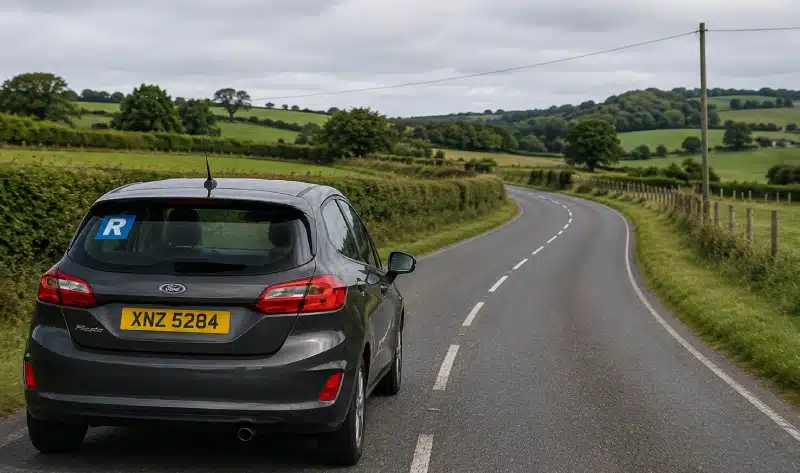
Much of the coverage of Northern Ireland's new Graduated Driver Licensing scheme has framed it as a city problem, urban young drivers with cars full of friends, motorway restrictions, city-centre policing. That framing gets the priority wrong. The single strongest justification for GDL sits in the rural data.
Look at where young drivers are actually involved in serious collisions in Northern Ireland, and the picture is unmistakable.
The Rural Concentration
According to the Department for Infrastructure's Graduated Driver Licensing monitoring report 2024, young car drivers aged 17-23 were involved in a disproportionate share of serious rural road casualties between 2020 and 2024. Their involvement in KSI collisions varies sharply by road type:
Put concretely: between 2020 and 2024, an average of 476 people a year were killed or seriously injured on Northern Ireland's rural roads. In 142 of those cases, a car driver aged 17-23 was involved. That's nearly one in three. On urban roads the same age group accounts for less than half that proportion.
When These Collisions Happen
The timing pattern is even more revealing than the road-type split. Among young passengers aged 14-20 travelling with a driver aged 17-23:
Weekend and late-night concentration
This is the exact behavioural profile the GDL restrictions are designed to disrupt: young drivers on rural roads at the weekend, at night, carrying multiple young passengers, sometimes travelling too fast for the conditions. The restrictions aren't arbitrary. They map onto the crash data.
Which Council Areas Feel It Most
The rural pattern translates into a marked difference in serious injury rates between council areas. The Road Safety Strategy annual statistical report published in August 2026 found that, in 2025, KSI rates per head of population were highest in two of Northern Ireland's more rural council areas:
Both are areas defined by rural road networks and dispersed populations. The DfI's own commentary on those numbers acknowledged the pattern: the increased casualty risk on less densely populated, often rural roads where speed limits tend to be higher than in urban areas.
What This Means Practically for Rural Young Drivers
The counter-argument you'll hear is that GDL is unfair on rural young drivers, because rural life demands more driving. Public transport in Antrim, Down, Tyrone, Armagh and Fermanagh is limited, distances are longer, and a car often isn't optional. That's real. The restrictions do land harder in rural areas than urban ones.
But the same data that makes rural driving unavoidable is what makes GDL matter more there. If you're a young driver in rural Northern Ireland, you're not driving through the same statistical landscape as a young driver in central Belfast. The rural road, at night, with peers in the car, is exactly where the risk concentrates. The restrictions are targeted rather than blanket.
The practical implications are straightforward. During the first six months after passing, phase 1 R plate drivers under 24 need to think carefully about the makeup of their car for late journeys, not because someone is trying to inconvenience them, but because the data on what happens to that combination on a country road at 1am is difficult to ignore.
If You've Been Injured on a Rural NI Road
Rural collisions tend to be different from urban ones in ways that matter for a personal injury claim. Speeds are usually higher, so injuries are often more severe. Emergency response times can be longer. Witnesses are fewer. CCTV is sparse. Dashcam footage from a passing vehicle is often the single most valuable piece of evidence.
Evidence preservation matters more in rural cases
If you've been involved in a rural road collision, act quickly to preserve dashcam footage (yours or a witness's), take photographs while the scene is still fresh, and note the names and details of anyone who stopped. A rural collision without independent evidence often comes down to competing accounts, and the party with the better contemporaneous documentation typically has the stronger position.
Where a young driver was in breach of a GDL condition at the time (carrying unauthorised passengers on a rural road late at night, for example), that breach is a fact worth flagging to your solicitor early. It doesn't automatically decide liability, but it can be relevant. Our guide to the new GDL rules explains the restrictions in full and how a breach may affect a claim.
If you've been injured in an accident, our road traffic accident team serves clients across the region from offices in Belfast, Glengormley and Carrickfergus.
Injured on a rural NI road?
Rural road cases often involve fewer witnesses and less obvious evidence. Acting quickly protects your position. A free consultation carries no obligation.